
Did you know that an estimated 60% of new products are off the shelves within three years? Turning an idea into a successful product isn’t a single “eureka” moment; it’s a disciplined, evidence-based journey. The process boils down to three core phases: validating your concept to confirm a real market need, building a minimal version (an MVP) to get it into users’ hands quickly, and launching it to the world to gather feedback for continuous improvement. This structured approach is your best defense against building something nobody wants.
Your Blueprint From Idea to Market-Ready Product
Every great product, from the iPhone to your favorite indie app, began as a simple thought. But the path from that initial spark to a product people love is where most entrepreneurs get lost. The key is to break the overwhelming journey into manageable, logical phases, starting with the most critical one: confirming your idea solves a painful, real-world problem.
This guide is your roadmap. We’ll walk through the same core stages that seasoned founders and product teams follow. The process begins with concept development, a foundational stage where you rigorously test your assumptions before investing significant time or money. This is where success is born.
The Core Product Development Lifecycle
Think of product development as a cycle, not a straight line. You are constantly learning, adapting, and refining based on real-world data. The diagram below breaks down the three foundational stages that keep you on track.
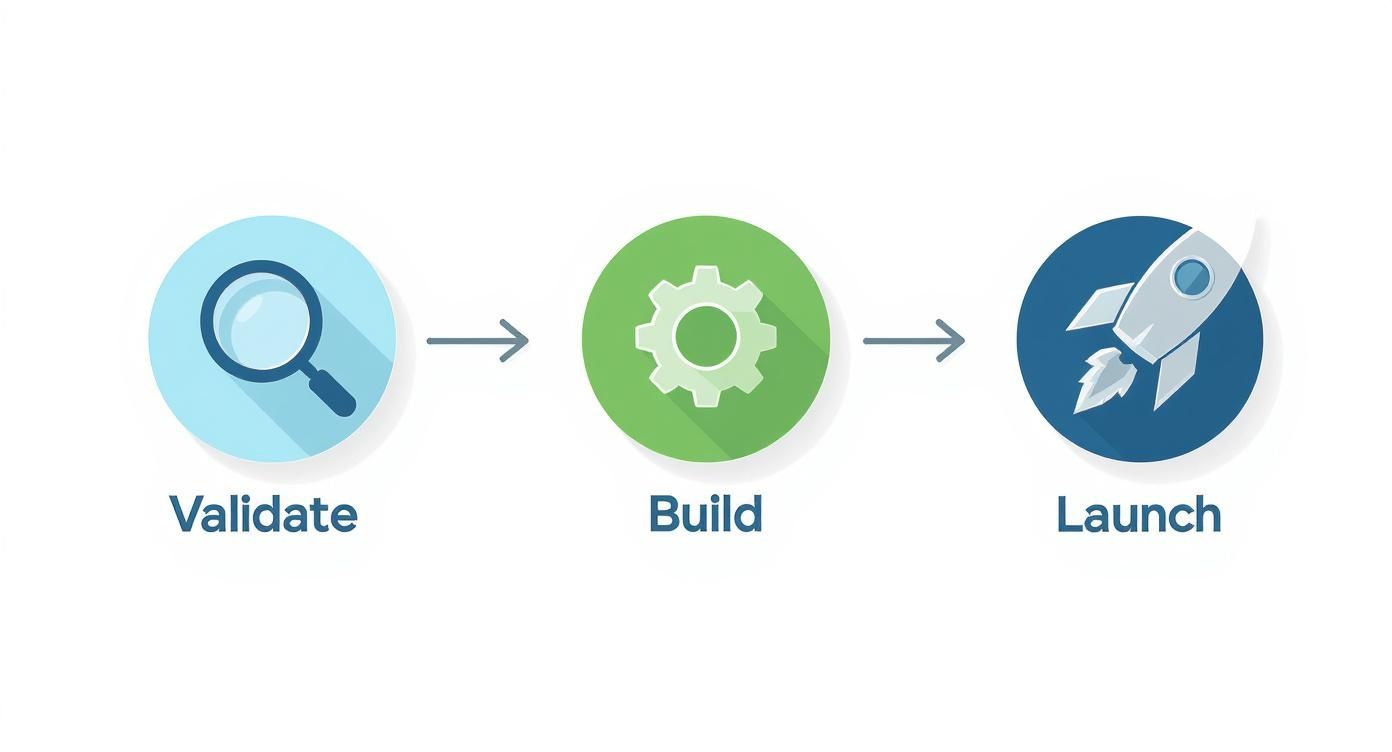
This Validate, Build, Launch loop is rooted in lean methodology. It forces you to learn from real users at every turn, which is the most effective way to de-risk your venture and avoid building a solution in search of a problem.
The biggest mistake you can make is building a solution for a problem that doesn’t exist. This entire blueprint is designed to protect you from that one, single fatal error.
The often-cited statistic that 90% of startups fail underscores a harsh reality: building a successful product is incredibly difficult. It’s why a solid, customer-focused process is non-negotiable. The table below breaks down these core stages and what you should be focused on in each one.
Core Stages of Product Development
| Stage | Primary Objective | Key Activities |
|---|---|---|
| Validate | Confirm a real market need for your idea. | Customer interviews, market research, surveys, competitor analysis, creating a value proposition. |
| Build | Develop a Minimum Viable Product (MVP). | Prioritizing core features, UX/UI design, agile development sprints, quality assurance testing. |
| Launch | Get the product into the hands of early adopters. | Creating a go-to-market strategy, gathering user feedback, monitoring key metrics, iterating on the product. |
Following these stages provides the structure and clarity needed to navigate the complexities of product development. This blueprint isn’t just for venture-backed startups; it’s a powerful framework for solo builders, indie hackers, and small teams. For a specialized look at this process for mobile applications, this Mobile App MVP Guide From Idea to Market Success is an excellent resource.
How to Validate Your Idea Before You Build Anything
The product graveyard is filled with brilliant ideas that, unfortunately, solved problems nobody actually had. Validation is your single best defense against that fate. It’s where you stop assuming and start collecting hard evidence that proves your idea has legs—before you write a single line of code or burn through your budget.
This isn’t about getting friends to tell you your idea is great. It’s about getting unbiased data from your target market that confirms you’re onto something real. The goal is simple: de-risk the entire project by proving a genuine market need exists.

Uncovering Genuine Pain Points
The best products don’t feel like vitamins; they feel like painkillers. They solve an urgent, nagging problem that people are already trying to fix. Your first job is to find that pain.
This starts with a process called customer discovery interviews. The trick is, you never pitch your idea. Instead, you get potential customers talking about their lives, work, and frustrations. When you ask the right questions, you’ll uncover the real challenges they face—which are often completely different from what you first imagined.
This is a skill that requires listening more than talking and asking open-ended questions about what people have done in the past, not what they might do in the future. A great place to start is to learn how to validate your business idea using The Mom Test .
From Conversations to Commitment
Once you’ve had those initial conversations, you need to see if people are willing to do more than just talk. Talk is cheap. Action is where the truth lies. Luckily, there are low-cost ways to test commitment.
One of the most effective methods is the “smoke test.” This is a simple landing page describing your product’s core value with a clear call-to-action, like “Sign Up for Early Access” or “Join the Waitlist.”
The data you get from this is pure gold:
-
Conversion Rate: What percentage of visitors sign up? For a new idea, a 5-10% conversion rate is a very strong signal of interest.
-
Cost Per Acquisition (CPA): If you’re running small ads to drive traffic, how much did it cost to get each signup? This gives you an early, real-world peek into your potential marketing costs.
A landing page that gets zero sign-ups isn’t a failure. It’s a massive success. It just saved you months of development and thousands of dollars building something nobody was ready to try.
This approach provides quantitative proof. You’re no longer guessing if people are interested—you’re measuring their actual behavior.
Gathering Actionable Validation Data
As you talk to people and run small tests, you need a system for analyzing what you’re hearing. The goal is to spot the patterns that either confirm or destroy your core assumptions.
Keep a sharp eye out for these signals:
-
Recurring Problems: Are you hearing multiple people describe the same frustration, often using the exact same words?
-
Existing “Hacks”: Have potential customers already cobbled together a clunky workaround using complex spreadsheets or multiple apps? This is a huge sign they’re actively seeking a better solution.
-
Emotional Language: Listen for words like “frustrating,” “so annoying,” or “time-consuming.” Emotion is a direct line to a real pain point.
-
Willingness to Pay: Do they ask about pricing? Even hypothetically, it means they’re already calculating the value in their head.
This validated user research becomes the bedrock of your entire product. It provides the rich context that will inform every decision you make later, from feature prioritization to marketing copy.
For anyone building a complex software or AI-driven tool, this research is the perfect fuel for a system like the Context Engineer MCP. By feeding it real-world pain points and user stories, you arm your development process with a crystal-clear understanding of the problem, dramatically improving the quality and relevance of the final product right from the start.
Designing Your Product With Speed and Precision
You’ve validated your idea—a huge win. Now, the fun begins: turning that validated need into a product blueprint. This stage is about shifting from conversations to concrete design, zeroing in on a Minimum Viable Product (MVP) that delivers real value right out of the gate.
The goal isn’t to cram in every feature you’ve dreamt of. It’s about ruthless prioritization. Build only what’s absolutely necessary to solve the single, burning problem for your first users. Everything else is noise that will slow you down and burn through cash.
This obsession with speed and lean development isn’t just a trend; it’s the industry standard. Data shows that over 80% of product developers are constantly seeking ways to shorten their timelines. It’s why MVP strategies are nearly universal, with a staggering 85% of product managers calling them essential for testing ideas in the real world.
From User Needs to Actionable Stories
The first step in any solid design process is translating customer research into clear, bite-sized tasks that a development team can build. This is the purpose of user stories. A user story is a simple, informal sentence that frames a feature from the user’s perspective.
The classic format is simple and effective: “As a [type of user], I want to [perform an action] so that I can [achieve an outcome].”
Here are a couple of real-world examples:
-
For a project management tool: “As a project manager, I want to see all my team’s tasks on one dashboard so I can quickly see who is on track and who is falling behind.”
-
For an e-commerce site: “As a shopper, I want to filter products by my size so I don’t waste time scrolling through items that won’t fit.”
These stories are powerful. They force you to justify every feature by tying it directly to user value, which is the best way to avoid building things nobody asked for.
Mapping the User Journey
Once you have a handful of core user stories, you need to map how someone will navigate your product to get things done. This is called a user flow. Think of it as a simple map showing the path a user takes from the moment they open your app to when they complete a key action, like signing up or making a purchase.
Mapping these flows is crucial because it forces you to walk in your user’s shoes. You’ll quickly spot confusing steps, dead ends, or frustrating loops before a single line of code is written. You don’t need fancy software—a whiteboard and sticky notes are often enough.
A clear user flow is the architectural blueprint for your user experience. It ensures the journey from Point A to Point B is intuitive and seamless, which is the foundation of a product people enjoy using.
These design documents—user stories, feature lists, and flowcharts—are the essential ingredients a development team needs. Many teams compile this into a Product Requirements Document (PRD). If you need a solid template, you can check out our guide on how to write a product requirements document .
Accelerating Design with AI-Powered Blueprints
Creating all these assets—user stories, diagrams, user flows—can be a slow, manual grind. This is where modern tooling can provide a significant edge.
Instead of staring at a blank page, you can feed your validated user research and prioritized feature list directly into an AI platform. An advanced system like the Context Engineer MCP can take this raw information and generate key design documents in a fraction of the time. Imagine uploading user interview transcripts and getting back a complete set of well-written user stories, a logical user flow diagram, and a recommendation for the technical architecture. This doesn’t just fast-forward the design phase; it helps eliminate misinterpretations between the product vision and the engineering team, ensuring the final blueprint is precise, clear, and ready for development.
Building Your Product Without Burning Through Cash
This is where your idea finally becomes a tangible product. It’s an exciting phase, but it’s also where most projects go off the rails, blowing through budgets and timelines. Building efficiently isn’t about cutting corners; it’s about being smart and deliberate to maintain momentum without wasting resources.
Forget rigid, year-long roadmaps. You need to be agile. Frameworks like Scrum or Kanban are designed for change, allowing you to work in short “sprints” to build and test small, usable chunks of your product. This iterative process allows you to gather real user feedback as you go, preventing the nightmare scenario of spending six months building a feature nobody wanted.
Picking the Right Tools for the Job
One of the most critical early decisions is choosing your tech stack. This isn’t just a technical debate; deciding between no-code and custom development is a strategic move that impacts your speed, cost, and future scalability.
There’s no one-size-fits-all answer. The right choice fits your project right now.
-
No-Code/Low-Code Platforms: Tools like Bubble , Webflow , or Adalo are fantastic for getting an MVP to market quickly, building internal tools, or creating products without highly complex features. You can cut development time from months down to weeks.
-
Custom Development: If your product has a unique user experience, involves complex backend logic, or needs to handle massive user loads, custom development is likely necessary. It offers total freedom but comes with higher costs and longer timelines.
The key is to match the tool to the task. Don’t commit to a six-figure custom build when a no-code tool can validate your concept for a fraction of the cost.
Creating a Single Source of Truth
One of the biggest momentum killers during a build is the communication gap between product managers, designers, and developers. A simple misunderstanding can lead to weeks of wasted work. This is why you need a central, undeniable source of truth for the entire team.
Financial hurdles are a classic part of learning how to turn an idea into a product. Top-performing companies have a serious edge, with development cycles that are 20-25% faster than the average. A big part of this efficiency is collaboration—nearly half (48%) of product teams are cross-functional. This report on product development statistics has some great data on this.
To keep your project from becoming a money pit, you must implement smart strategies to reduce software development costs . This almost always starts with eliminating ambiguity.
A developer’s worst nightmare is building a feature based on a misunderstanding. Every hour spent on rework is an hour you’re not spending on pushing the product forward. Clear, consistent context is your best defense.
This is precisely the problem the Context Engineer MCP was built to solve. By feeding it all your approved product specifications, user stories, and design files, you create an AI-powered knowledge base that becomes the project’s definitive guide. When developers or their AI coding assistants have a question, they query a single, high-quality context hub instead of digging through old emails or Slack messages. This slashes confusion, drastically reduces AI code hallucinations, and ensures what gets built is exactly what was planned, saving incredible amounts of time and keeping the project on schedule.
How to Launch Your Product and Gather Actionable Feedback
You’ve built your product. It’s easy to think this is the finish line, but it’s just the beginning. The launch is where your assumptions meet reality. Everything you gather from this point forward will shape what your product becomes. Forget a single, splashy launch day; think of it as opening the doors to start a real conversation with your first users.
Your main goal is to get out of the theoretical and into the real world as quickly as possible. The insights you’ll gain in the first few weeks are pure gold—worth more than months of internal debate. This phase is all about listening, measuring, and iterating your way to a product people genuinely want.
Choosing Your Launch Strategy
Not all launches are created equal. While a huge public reveal sounds exciting, a quieter, controlled start is almost always the smarter move for a new product. Your strategy should align with your immediate goals.
Let’s break down the two main paths:
-
Soft Launch (Beta Launch): You release your product to a small, hand-picked group, such as people from your waitlist or a niche community. The goal is to find bugs, get honest feedback on the user experience, and ensure your core features solve the problem before the whole world sees it.
-
Hard Launch (Public Launch): This is the big “we’re live!” moment. You push it out through press releases, social media campaigns, and maybe a feature on Product Hunt . This approach only makes sense when you’re confident your product is stable and you have a solid go-to-market plan.
For 9 out of 10 founders, a soft launch is the way to go. It provides a safe space to learn and improve without the pressure of a public audience.
Setting Up Your Feedback Machine
You can’t fix what you can’t see. Before a single person signs up, you need a system for collecting analytics and feedback. This isn’t about chasing vanity metrics; it’s about understanding what people are actually doing inside your product.
Here are the essentials you need from day one:
-
Behavioral Analytics: Tools like Mixpanel , Amplitude , or a well-configured Google Analytics are non-negotiable. They show you exactly which features people use, where they get stuck, and which parts they ignore.
-
Direct Feedback Channels: Make it ridiculously easy for users to get in touch. This could be an in-app feedback widget, a dedicated support email, or a community on Discord or Slack .
-
Surveys: Use short, targeted surveys to ask specific questions. A Net Promoter Score (NPS) survey is a fantastic way to quickly gauge overall user satisfaction.
Actionable feedback is the lifeblood of a new product. Your job isn’t to defend your initial idea; it’s to listen intently and let your customers guide you to the product they actually need.
Combining hard numbers from analytics with qualitative insights from conversations gives you the full story of what’s working and what’s not.
To keep things organized, it helps to track a handful of key metrics from the very beginning. This table breaks down what you should be looking at.
Key Metrics for Post-Launch Analysis
| Metric Category | Example Metrics | What It Tells You |
|---|---|---|
| User Engagement | Daily/Monthly Active Users (DAU/MAU), Session Duration | Are people coming back? Are they finding enough value to stick around? |
| Feature Adoption | % of users trying a key feature, Feature retention rate | Are people using the core functionality you built? Which features are most popular? |
| User Satisfaction | Net Promoter Score (NPS), Customer Satisfaction (CSAT) | How do users feel about your product? Are they likely to recommend it? |
| Product Health | Bug report volume, App crash rate, Load times | Is the product stable and performing well from a technical standpoint? |
| Conversion & Growth | Sign-up rate, Paid conversion rate, Churn rate | Are you successfully turning visitors into users and users into paying customers? |
This data provides the objective truth about how your product is performing in the wild, cutting through biases and assumptions.
Turning Feedback into Your Next Steps
Getting feedback is the easy part; knowing what to do with it is the real challenge. You’re going to get a flood of bug reports, feature requests, and random comments. You need a simple way to sift through it all and find the patterns that matter.
A simple but effective approach is to categorize every piece of feedback by Impact and Effort.
-
Impact: How many users does this affect? How badly does it affect them?
-
Effort: How much time and resources will it take your team to build or fix this?
This helps you prioritize the quick wins—the high-impact, low-effort changes that deliver immediate value to your users. This disciplined cycle of listening, learning, and adapting is the final, essential step in how to turn an idea into a product that actually succeeds.
Common Questions About Turning an Idea Into a Product
The path from a spark of an idea to a real-world product is never a straight line. It’s full of questions, tough calls, and unexpected turns. To help you navigate it all with a bit more confidence, let’s tackle some of the most common questions I hear from founders and innovators.
How Much Does It Typically Cost to Turn an Idea Into a Product?
This is the classic “how long is a piece of string?” question, but I can give you some real-world numbers to anchor your expectations. The final price tag for bringing your concept to life depends heavily on its complexity, who you hire, and the tech stack you choose.
For example, a simple Minimum Viable Product (MVP) for a mobile app might run you anywhere from $10,000 to $50,000 if you go with a development agency. If you’re building something more complex with custom features, tricky integrations, and a heavy-duty backend, that number can easily climb past $100,000.
What drives these costs? It boils down to a few key things:
-
Scope of Work: The number and complexity of your features are the biggest factor by a long shot.
-
Development Rates: A freelance developer in North America will have a very different rate than a team based offshore.
-
Design Needs: Custom UI/UX design, branding, and slick animations all add up.
-
Platform: Building native apps for both iOS and Android is more expensive than using a cross-platform framework to build once.
For founders just starting out, no-code and low-code platforms are fantastic options. They let you build and test an early version of your product without a massive upfront investment.
How Do I Protect My Product Idea From Being Stolen?
This is a fear every founder has, but let me be direct: execution almost always wins out over the idea itself. Your best defense is to build, learn, and iterate faster and better than anyone else. That said, there are some practical steps you should take to protect your intellectual property.
First, get comfortable with Non-Disclosure Agreements (NDAs). Use them before you dive into the nitty-gritty with contractors, potential partners, or investors. An NDA is a simple legal contract that establishes a confidential relationship and gives you some recourse if someone shares your secrets.
Next, get familiar with the different types of legal protection:
-
Patents: Best for truly unique inventions or processes. A provisional patent application can lock in your idea for a year while you build it out.
-
Copyrights: This protection is automatic. It covers your source code, website copy, and other creative work from being copied outright.
-
Trademarks: This protects your brand identity—your name, logo, and slogan—so no one else in your industry can use a confusingly similar one.
Ultimately, speed is your greatest weapon. Great ideas are a dime a dozen. The ability to relentlessly execute on one is what’s rare. Focus on building unstoppable momentum.
What Is the Most Common Reason New Products Fail?
I’ve seen it time and time again. The number-one killer of new products is a lack of product-market fit.
Simply put, you built something nobody truly wants. Either the problem you’re solving doesn’t actually exist, it isn’t painful enough for people to pay for a solution, or your product just doesn’t solve it well. This fatal mistake almost always happens when founders skip or rush through the idea validation stage we talked about earlier. They fall in love with their solution before they’ve truly confirmed the problem.
Of course, other things can go wrong too:
-
Running out of cash before you get traction.
-
Terrible marketing and distribution, so your ideal customers never even hear about you.
-
Getting outmaneuvered by a competitor who is faster or has deeper pockets.
-
A broken business model that makes it impossible to ever turn a profit.
An honest, rigorous validation process is the best insurance you can buy against the main cause of product failure. Don’t skip it.
Should a Non-Technical Founder Learn to Code?
Probably not. As a founder, your time is your most precious asset. It’s almost always better spent on the things only you can do: talking to customers, marketing, fundraising, and setting the overall strategy.
You have plenty of great options for getting your product built without becoming a developer yourself:
-
Find a technical co-founder: This is often the best-case scenario. You get a dedicated partner who is just as invested in the product’s success as you are.
-
Hire freelance developers or an agency: This gives you instant access to expert talent, but it requires a clear budget and active management on your part.
-
Use no-code platforms: For many types of products, tools like Bubble or Webflow can help you build a fully functional V1 without writing a single line of code.
While you don’t need to become a senior engineer, it is incredibly helpful to learn the basics. Understanding the technology will make you a better leader, help you communicate more effectively with your technical team, and empower you to make smarter strategic decisions.
Ready to accelerate your build phase and eliminate the costly rework caused by AI hallucinations? Context Engineering provides the precise, project-specific context your AI coding assistants need to generate production-ready code. Start building faster and smarter today at https://contextengineering.ai .