The core difference between context engineering and prompt engineering boils down to a single question: Are you manually crafting a one-off instruction, or are you architecting an automated system? Prompt engineering is the manual craft of writing specific instructions for a single AI task. Context engineering is the automated science of building systems that consistently feed an AI all the information it needs to handle complex jobs with production-grade accuracy.
While 60% of developers report regularly fine-tuning prompts (a Stanford study statistic), leading AI labs are proving that systemic context delivery is the key to reliability. Research from Anthropic, for example, demonstrated that providing structured context can slash AI hallucination rates by over 40% compared to using standalone prompts. This shift from manual tweaking to systemic design is the most critical evolution in applied AI today.
Defining the Core Disciplines

As Large Language Models (LLMs) become central to modern software, our methods for interacting with them are maturing. What began as a creative, almost artistic, process is now evolving into a formal engineering discipline. Understanding the distinction between prompt and context engineering is essential for building AI applications that are both reliable and scalable.
What is Prompt Engineering?
Prompt engineering is the practice of carefully crafting and refining text inputs to guide an LLM toward a desired output for a specific task. Think of it as giving a brilliant but inexperienced intern a hyper-detailed to-do list for a single assignment. The success of the outcome depends entirely on the clarity and precision of those instructions.
For a deeper dive, we have a complete guide on what is prompt engineering .
What is Context Engineering?
Context engineering, in contrast, is the discipline of architecting the entire information system around the LLM. Instead of a manual to-do list, you build an automated briefing system. This system programmatically fetches project files, retrieves real-time data from APIs, and consults user histories, then structures this information perfectly for the LLM every time. This ensures the model has precisely what it needs to perform complex tasks independently and consistently.
Context engineering treats the LLM as a powerful reasoning engine within a larger information system, not as a magical black box to be manipulated with clever wording. The goal shifts from one-off perfection to systemic reliability.
To make this distinction crystal clear, here’s a quick side-by-side comparison.
Prompt Engineering vs Context Engineering at a Glance
This table offers a high-level summary of the fundamental differences between the two engineering approaches.
| Attribute | Prompt Engineering | Context Engineering |
|---|---|---|
| Primary Goal | Elicit a specific, high-quality output for a single task. | Build a reliable, scalable system that performs tasks consistently. |
| Core Method | Manual and iterative crafting of text instructions. | Automated retrieval and structuring of relevant data. |
| Analogy | A skilled artisan hand-crafting a perfect sculpture. | An industrial designer creating a robust assembly line. |
| Focus | The instruction given to the LLM. | The information system that feeds the LLM. |
| Scalability | Low; becomes brittle and hard to maintain at scale. | High; designed for production environments and complex workflows. |
In short, one is about perfecting the question, while the other is about perfecting the system that provides the answers.
Comparing Strategic Goals and Core Workflows

While both disciplines aim to elicit useful responses from an LLM, they approach the problem from fundamentally different angles. Their strategic goals and day-to-day workflows are distinct, and understanding this difference is crucial for deciding which approach fits your project’s needs.
Prompt engineering is a sprint focused on immediate, task-specific perfection. The objective is to craft the ideal instruction to generate a flawless result for one specific interaction. This makes it an excellent skill for rapid prototyping, creative exploration, or solving one-off problems.
Context engineering, however, is a marathon focused on long-term stability and performance. The goal is to create predictable, scalable, and resilient AI systems. It operates on the principle that for any production application, you cannot rely on perpetual manual prompt-tweaking. The real engineering work lies in building an architecture that automatically feeds the LLM the correct, verified information every single time.
The Artisan vs. The Industrial Designer
A powerful analogy is the comparison between a skilled artisan and an industrial designer.
The prompt engineer is the artisan, meticulously hand-crafting a single, beautiful chair. They pour all their expertise into the details of that one creation to make it flawless. Their workflow is a tight, manual loop: write, test, refine, repeat.
The context engineer is the industrial designer, creating the entire assembly line to produce thousands of those perfect chairs, identically and efficiently. Their focus isn’t on any single chair but on the whole production system—the automated processes, the quality checks, and the data supply chain that ensures every product meets spec, reliably and at scale.
The core workflow difference is the shift from a manual, iterative cycle focused on a single prompt to an automated, systemic process focused on the entire data pipeline. This transition is essential for building production-grade AI.
This is where the disciplines of context engineering vs prompt engineering truly diverge.
A Closer Look at Core Workflows
Let’s break down what these workflows actually look like. One is a creative loop; the other is a full-blown architectural build.
The Prompt Engineering Workflow:
This is a hands-on, iterative process.
- Hypothesize: Start with an idea for a prompt you believe will work.
- Craft: Manually write the prompt, carefully choosing words, adding instructions, and perhaps providing examples (few-shot learning).
- Test: Run the prompt with a specific input and evaluate the LLM’s output.
- Refine: Analyze the output for flaws, then return to tweak the prompt’s wording or structure. This loop repeats until the result is satisfactory for that one task.
This process can yield impressive results, but it’s often brittle. A prompt that works perfectly today might fail tomorrow after a minor model update. For a deeper look, check out our guide to AI prompt engineering .
The Context Engineering Workflow
This workflow is far more systematic and architectural.
- Design: Architect the entire data pipeline. This involves identifying where crucial information resides—in databases, APIs, or document stores—and designing a system, often using Retrieval-Augmented Generation (RAG), to fetch it.
- Implement: Build the automated processes that retrieve, filter, and structure that data into a clean, optimized payload for the LLM. The focus is on writing code to prepare data, not on writing prose for the prompt.
- Integrate: Create a lean, reusable prompt template that simply instructs the LLM on how to use the rich context it has been provided. The data pipeline does the heavy lifting; the prompt acts as a final guide.
- Monitor: Establish continuous monitoring to track system accuracy, reliability, and token costs, allowing for data pipeline optimization over time.
This approach, guided by a formal framework like Methodical Context Provisioning (MCP), creates a durable system that doesn’t depend on finding the “magic words.” It’s about building a solid foundation for reliable AI. The Context Engineer MCP server, for instance, is designed to implement this workflow directly within a developer’s environment, streamlining the creation of these robust data pipelines.
See Context Engineering in Action
Want to see how this systematic approach works in practice? Watch this tutorial demonstrating the Context Engineer MCP setup, planning workflows, and how to maintain the right balance of context for AI coding agents:
Learn how to set up planning sessions, analyze your codebase for patterns, generate comprehensive PRDs, and control information flow to keep AI agents focused and accurate.
How Each Method Impacts AI Performance
The way you provide information to a Large Language Model (LLM) is the single most important factor determining its performance, reliability, and tendency to hallucinate. The true impact of context engineering vs prompt engineering becomes undeniable when you analyze the inputs and outputs.
With prompt engineering, the input is a carefully constructed, often lengthy, string of text. It’s a static instruction, custom-built for one specific task, where every word is chosen to steer the model.
Context engineering, conversely, uses a dynamic data payload. It pairs a simple, reusable prompt template with a rich package of relevant, structured information—like user history, specific documents, or live data from an API. The LLM isn’t just getting an order; it’s getting a full, real-time briefing.
The Brittle Nature of Prompt-Driven Outputs
Relying solely on prompt engineering often produces brittle results. An LLM’s performance becomes tightly coupled to the exact phrasing of the prompt, meaning a minor change can cause quality to plummet. A prompt that works today might break tomorrow after an LLM provider pushes an update, trapping you in a perpetual maintenance cycle.
This fragility makes prompt-engineered systems a high-risk gamble in production environments where consistency is paramount. The quality is fragile because it’s based on linguistic tricks, not verifiable data. An LLM operating without external facts is essentially guessing in a vacuum, which dramatically increases the risk of hallucination (inventing answers).
The biggest performance risk with prompt engineering is its total reliance on the model’s internal knowledge, which can be outdated, biased, or simply wrong. Context engineering sidesteps this problem by grounding the model in external, verifiable facts for every single task.
Achieving Robustness with Context-Grounded Outputs
Context engineering leads to far more robust and reliable outputs because it fundamentally changes the LLM’s job. Instead of asking the model to remember information from its vast training data, you’re asking it to synthesize an answer from the specific, verified information you just provided. This technique is called grounding.
When an LLM is grounded, its answers are anchored to a source of truth. This drastically reduces hallucination—the industry term for when an AI confidently states falsehoods. For any serious business application where accuracy is non-negotiable, this is a game-changer. The system becomes dependable because its logic is built on facts, not just probabilistic word patterns.
For example, a case study from Anthropic found that adding structured context—like using XML tags to define background info and provide clear output templates—slashed hallucination rates by 40% compared to just using a standalone prompt. You can explore more research on structured context improvements to see just how much data formatting can improve AI reliability. This data-first approach is the foundation for building AI you can actually trust.
A Practical Performance Comparison
To really see the difference, let’s imagine a customer support chatbot for an e-commerce store handling a common question.
Scenario: A user asks, “What’s the return policy for international orders?”
-
Prompt Engineering Approach: You’d have to write a complex, all-in-one prompt.
- The Prompt: “You are a helpful customer service agent. A customer is asking about international returns. Access your internal knowledge and explain our policy clearly. Mention the 30-day window, the customer’s responsibility for shipping costs, and the process for initiating a return through the online portal. Use a friendly but professional tone.”
- Performance Impact: The answer is only as good as the LLM’s memory. If your return policy changed last week, the model will confidently provide outdated, wrong information. The result? An unhappy customer and a potential loss of business.
-
Context Engineering Approach: This approach uses a system to grab the facts first.
- The system automatically queries a knowledge base for the “international return policy.”
- It pulls the latest, up-to-date policy document.
- It then bundles that document into a structured context payload and pairs it with a dead-simple prompt: “Using the provided document, answer the user’s question about the international return policy.”
- Performance Impact: The output is consistently accurate and reliable. The LLM isn’t trying to remember anything; it’s simply summarizing the fresh, verified data it was just given. The system is now resilient to policy changes, and the user always gets the right answer.
Choosing the Right Engineering Approach
Deciding between prompt engineering and context engineering isn’t about picking a “better” method; it’s about matching the right tool to the job. The optimal path depends entirely on your application’s requirements for scale, reliability, and accuracy.
For quick experiments, one-off creative tasks, or simple chatbots where the stakes are low, prompt engineering is often the most efficient starting point. It’s hands-on and iterative, allowing you to get results immediately without building significant infrastructure. Need to brainstorm social media posts or summarize an article? A well-crafted prompt is the fastest way there.
However, the moment your application must be consistent, handle private company data, or serve real users in a production environment, the conversation must shift to context engineering.
When Context Engineering Becomes Essential
For any serious business application, reliability is non-negotiable. The manual, often fragile nature of prompts is too risky when real business outcomes are on the line.
Context engineering is mission-critical in scenarios like these:
- Enterprise Q&A Systems: When employees need accurate answers from your internal knowledge base, you cannot hope the LLM “remembers” the right policy. The system must retrieve the latest, most accurate documents to avoid disseminating dangerously outdated information.
- Personalized User Experiences: To create an experience that feels truly tailored, the application must draw from a user’s past behavior, stated preferences, and real-time actions. This dynamic data injection is the core function of context engineering.
- Complex Data Analysis: If you want an AI to analyze a sales report, it needs the actual sales report. If it’s debugging code, it needs the codebase and error logs. A system must be in place to feed it this essential, real-time information.
- High-Stakes, Auditable Applications: In regulated industries like finance or healthcare, every AI-assisted decision must be traceable to a source of truth. Context engineering creates this audit trail by grounding every output in specific, verifiable data.
This decision tree provides a visual guide for making this choice.
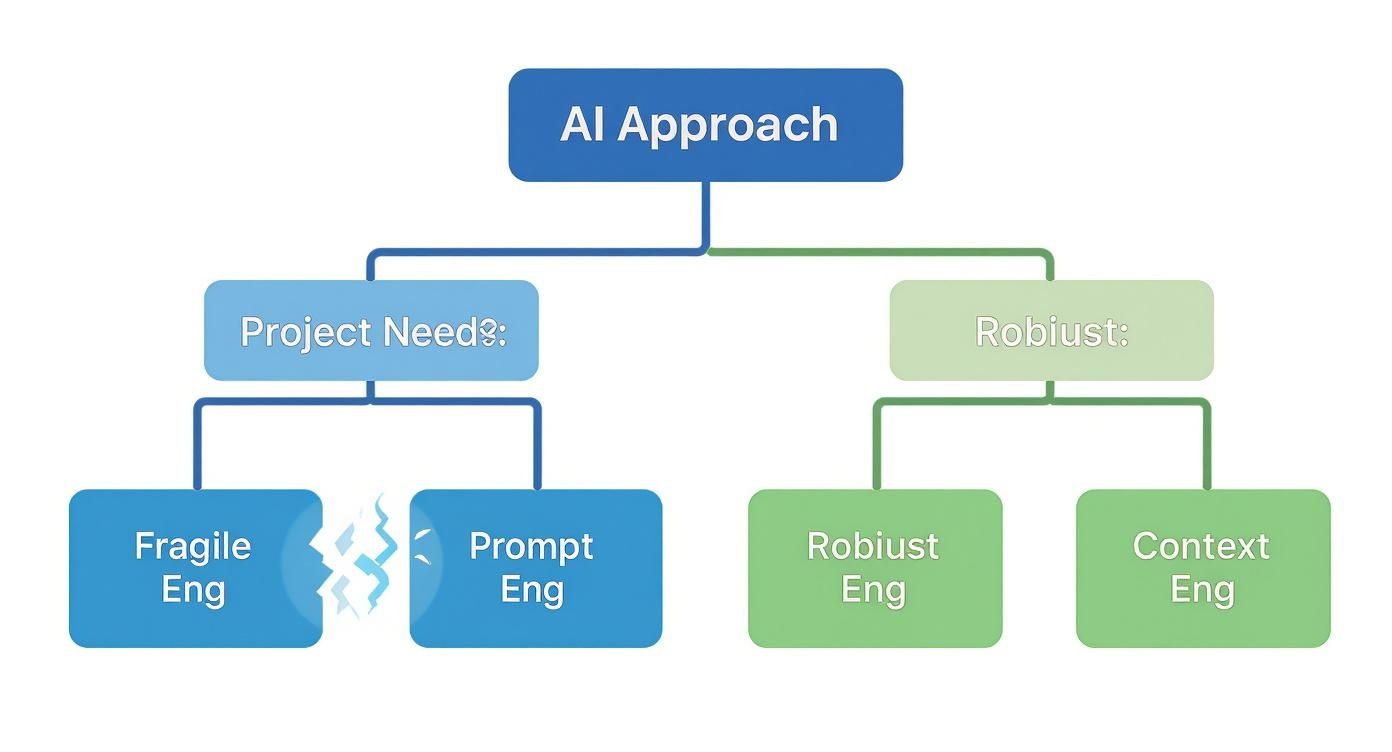
As you can see, prompt engineering is perfect for fragile, one-off tasks. But for anything robust and built to last, a context-first architecture is the only viable path.
A Practical Decision Framework
Choosing the right approach becomes clearer when you evaluate your project against a few key criteria. Use this matrix to make a pragmatic decision based on your application’s demands.
Decision Matrix for Prompt vs Context Engineering
| Requirement | Choose Prompt Engineering If… | Choose Context Engineering If… |
|---|---|---|
| Scale | You’re building a simple demo, a one-off tool, or a feature with very low traffic. | The application will handle hundreds or thousands of daily requests with diverse user needs. |
| Reliability | The cost of an incorrect or inconsistent answer is low (e.g., creative brainstorming). | A wrong answer could lead to lost revenue, poor user experience, or legal risk. |
| Accuracy | General knowledge is sufficient, and occasional “hallucinations” are acceptable. | The AI’s outputs must be factually correct and verifiable against a trusted data source. |
| Data Needs | The task relies only on the LLM’s public training data. | The task requires private, proprietary, or real-time information that is not in the LLM’s training data. |
| Maintenance | A single developer can tweak prompts as needed; long-term maintenance isn’t a major concern. | A team needs to manage the system, and changes must be testable, versioned, and auditable. |
Ultimately, the choice comes down to moving from a prototype mindset to a production-ready one.
The move from prompt engineering to context engineering isn’t a failure—it’s a sign of maturity. It shows an AI application is evolving from a clever experiment into a dependable, mission-critical system.
Adopting a structured approach like Methodical Context Provisioning (MCP) gives teams a formal playbook for making this transition. It provides the architectural patterns needed to build the data pipelines and retrieval systems that make AI outputs both powerful and predictable. By focusing on the system that feeds the model, you start building applications that are resilient by design.
What Scaling Prompt Engineering Really Costs You
During initial prototyping, prompt engineering feels like a superpower—it’s fast, direct, and delivers immediate results. But this initial simplicity is deceptive. As an application scales from a demo to a real-world product, the hidden costs in maintenance time, operational risk, and token expenditure begin to mount.
The fundamental issue is that a system built on hundreds of hand-tuned prompts is inherently fragile. Each prompt is a potential point of failure, a delicate construct that can collapse with the slightest change. As your application grows, you aren’t just adding features; you’re multiplying these points of failure into a tangled web that becomes a maintenance nightmare.
The Maintenance Treadmill
The first major issue teams encounter is “prompt sprawl.” You start with five perfect prompts. Soon, you need variations for new features and edge cases. Before you know it, you’re managing hundreds of unique assets, each requiring individual tracking, testing, and maintenance.
This is not a trivial problem. We’ve seen engineering teams burn up to 30% of their time just tweaking and fixing prompts that suddenly stopped working after a model update. That’s precious time spent on reactive maintenance instead of proactive innovation.
- Versioning chaos: Without a proper system, tracking changes across hundreds of prompts becomes nearly impossible.
- Zero reusability: Most prompts are so task-specific that you end up reinventing the wheel for slightly different use cases.
- Painful onboarding: How do you explain the subtle “magic” behind 50 critical prompts to a new developer? The undocumented art is often lost.
Brittleness and the Business Risk
The most dangerous cost, however, is the system’s brittleness. A prompt that is flawless today can break completely after a routine update from your LLM provider. Your application logic isn’t based on stable, structured data; it’s tied to the opaque internal state of a model you don’t control.
Consider a critical prompt that generates financial summaries. If it starts failing silently due to a model update, the business impact could be catastrophic. This risk forces your team into a constant state of defensive monitoring, waiting for the next fire to put out.
When your system’s reliability hinges on the exact phrasing of an instruction, you haven’t built an engineering solution. You’ve built a liability. A single model update can bring it all crashing down.
This is where the context engineering vs prompt engineering debate becomes a strategic business decision. A context-driven architecture is stable by design because its logic is based on data pipelines you can audit, version, and control.
The Unseen Drain of Token Costs
Finally, there is the direct financial impact: token inefficiency. To make prompts more reliable, a common tactic is to cram them with detailed instructions, multiple examples (few-shot learning), and hard-coded rules. This can temporarily boost accuracy but creates enormously long—and expensive—prompts.
Once your application handles thousands of requests a day, these bloated prompts burn through tokens at an unsustainable rate, causing operational costs to spiral.
Context engineering inverts this model. It uses lean, reusable prompt templates while an efficient data system fetches only the precise information needed for the task. The result is a much shorter, cheaper prompt that yields a more accurate, grounded answer. While it requires more upfront architectural planning, this approach dramatically reduces your long-term total cost of ownership.
Making the Move to a Context-Driven AI System

Transitioning from a system built on elaborate prompts to one driven by dynamic context is a clear sign of an AI application’s maturation. It’s the natural evolution from a clever proof-of-concept to a reliable, production-grade system. This isn’t an overnight switch; a phased, deliberate migration makes the process manageable for any engineering team.
The goal is to replace fragile, hand-tuned prompts with an automated system that consistently provides the LLM with exactly what it needs to perform, turning manual tweaks into codified, repeatable processes.
Phase 1: Audit and Map Out Your Dependencies
First, take stock of your existing system. Conduct a thorough audit of all prompts to identify where your application relies most heavily on static, hard-coded information. You are looking for patterns and shared data dependencies.
Ask these key questions:
- Are we explaining the same company policy in five different prompts?
- Do we have customer data embedded in prompts that could be pulled in dynamically?
- Which prompts are the most complex and therefore the most likely to break?
This audit creates a roadmap, highlighting the prompts that are prime candidates for a context-driven refactor and helping you focus on the highest-impact areas first.
Think of this audit as searching for the low-hanging fruit. Your goal is to spot prompts you can immediately improve by swapping static text for dynamic data. This strategy delivers quick wins and builds momentum for the bigger architectural shift.
Phase 2: Build Your Foundational Retrieval System
Once you know what data your prompts need, it’s time to build the machinery to fetch it. This typically means establishing a foundational data retrieval system, which will become the core of your context engine. For many teams, this starts with implementing a vector database.
Vector databases excel at storing and retrieving information based on semantic meaning, not just keywords. This makes them ideal for finding the most relevant documents or data snippets to address a user’s query. Your retrieval system acts as an automated librarian, pulling the right books off the shelf for the LLM to read before it formulates an answer. You can get a deeper look into how this works by reading about the fundamentals of context engineering .
Phase 3: Refactor Prompts and Set Up Monitoring
With your retrieval system in place, you can begin refactoring your most complex prompts. The objective is to strip them down into lean, reusable templates. Instead of a long, convoluted instruction manual, the new prompt template simply tells the LLM how to use the dynamic context it is about to receive.
For example, a 500-word prompt might shrink into a simple 50-word template that just waits for a {{context}} variable to be filled in by your data pipeline.
As you deploy these changes, robust monitoring is absolutely essential. You need to track key metrics to validate that the migration is successful.
- Accuracy Gains: Measure the rate of correct answers and compare it to the old prompt-based system.
- Hallucination Reduction: Track how often the model invents information. This number should drop significantly.
- Token Cost Savings: Monitor your API usage. Shorter, more efficient prompts directly translate to lower operational costs.
Following a phased approach ensures your team can build AI systems that are both maintainable and efficient. Adopting a structured framework like Methodical Context Provisioning (MCP) provides a clear blueprint for this transition, turning the art of prompt writing into the science of system building. This is precisely what tools like the Context Engineer MCP server are designed to facilitate, offering a structured path to production-grade AI.
Frequently Asked Questions
As teams navigate the nuances of context engineering and prompt engineering, several key questions consistently arise. Let’s address them directly to clarify the path forward for building superior AI systems.
Is Prompt Engineering Becoming Obsolete?
Not at all. Prompt engineering isn’t disappearing, but its role is evolving. Think of it less as a standalone discipline and more as a crucial skill within the broader field of context engineering.
A well-crafted prompt template remains vital. Its new purpose, however, is to instruct the LLM on how to behave with the rich, dynamic data it receives from the context engine—not to cram all the necessary information into the prompt itself. The focus shifts from “what to know” to “how to act.”
What Is the Biggest Challenge When Starting with Context Engineering?
The primary hurdle is the mental shift from prompt-level thinking to system-level architecture. It requires moving beyond clever wordsmithing and into data pipeline design, retrieval system implementation, and context formatting logic. At its core, it is a data and systems engineering problem, not a linguistic one.
The initial learning curve is about graduating from an LLM “whisperer” to an AI system architect. That’s why having a structured framework to follow is so important for engineering teams just starting out.
Frameworks like Methodical Context Provisioning (MCP) provide this essential blueprint, guiding teams through the architectural steps required to build a robust and reliable context delivery system.
Can I Use Both Engineering Techniques Together?
Absolutely—and you should. The most powerful AI applications use them in tandem. They are complementary, not competing, disciplines.
Context engineering builds the reliable, automated foundation—the machinery that delivers the right information at the right time. Prompt engineering then applies the finishing touches to the final instruction. It helps shape the LLM’s output to match a specific tone, format, or style once all the facts are in place. When combined, you create systems that are both factually accurate and perfectly tailored to the task at hand.
Ready to move beyond brittle prompts and build truly reliable AI applications? The Context Engineering MCP server integrates directly into your IDE to provide the architectural foundation your AI agents need. Automate context delivery, eliminate hallucinations, and build scalable, production-grade features from day one. Explore the future of AI development at https://contextengineering.ai .