In 2024, AI is projected to add a staggering $4.7 trillion to the global economy. Yet, many businesses struggle to get reliable results from their AI systems. Why? Because Large Language Models (LLMs) have a finite attention span, known as a “context window.” Dumping irrelevant data into this window leads to slower, less accurate, and significantly more expensive answers.
A context router acts as an intelligent traffic controller for your AI. It sits between a user’s query and the LLM, meticulously figuring out the exact information needed to answer that question, and then sending only that. This isn’t just an optimization—it’s the critical component for building enterprise-grade AI that works.
Why AI Systems Need a Traffic Controller
Imagine asking a brilliant research assistant a complex question. Instead of handing them a few key articles, you point to an entire library and say, “The answer is in there.” They’d waste most of their time just figuring out which books to open.
That’s the exact problem modern AI models face without proper guidance. A context router for AI systems is the expert librarian who instantly knows which documents, code snippets, or data sources to grab before handing them to the researcher.
This isn’t just a nice-to-have; it’s a core requirement. By intelligently filtering what gets sent to the model, a context router delivers three massive wins:
-
Better Accuracy: By cutting out noisy, conflicting, or useless information, you get more precise outputs and reduce AI “hallucinations” by up to 80%.
-
Faster Responses: The AI processes smaller, more relevant packets of information much faster, improving user experience with lower latency.
-
Lower Costs: Most LLM APIs charge based on the volume of data sent (tokens). A context router is your best tool for slashing operational costs, often reducing token usage by 70-90%.
This table breaks down these core responsibilities, showing how each piece contributes to a smarter, more efficient AI system.
Core Functions of a Context Router
| Function | Description | Primary Benefit |
|---|---|---|
| Context Selection | Intelligently identifies and retrieves the most relevant data from various sources (databases, documents, code) based on the user’s query. | Drastically improves the accuracy and relevance of the AI’s response. |
| Routing | Directs the user’s query and the selected context to the best-suited model or tool for the specific task. | Optimizes for performance, cost, and capability by using the right tool for the job. |
| Prioritization | Organizes the selected context, placing the most critical information where the LLM is most likely to “see” it. | Prevents important details from getting lost and helps the model reason more effectively. |
| Token-Efficiency | Actively works to minimize the amount of data (tokens) sent to the LLM by summarizing or excluding redundant information. | Significantly reduces API costs and speeds up response times. |
Each of these functions plays a vital role in transforming a powerful but unfocused LLM into a sharp, efficient, and reliable tool.
The Growing Need for Intelligent AI Infrastructure
The demand for this kind of smart infrastructure is exploding. As 97% of business owners believe AI will be a key advantage, the market for AI components is on a steep upward trajectory, forecasted to grow into a multi-hundred billion dollar industry. This massive growth signals a clear realization: you can’t just throw data at these models and hope for the best.
This is where the discipline of context engineering comes in—a structured approach to feeding information to AI. Getting this right is fundamental. For a deeper dive, check out this guide on building AI tools for enhanced data privacy and context awareness .
You can learn more about this foundational approach in our guide on what context engineering is and why it matters . By mastering how context is selected and delivered, developers can build AI applications that are worlds more capable and dependable.
How a Context Router Works Under the Hood
The best way to understand a context router is to see it as a dynamic system—a highly efficient research assistant preparing a critical briefing for an executive. It doesn’t just find information; it intelligently selects, refines, and delivers it.
At its heart is an Intelligent Orchestrator. When you submit a query—like a question about your codebase—the orchestrator is the first to see it. Its primary job is to understand the intent behind your request and determine precisely what information the AI will need to answer it well.
The Information Gathering Process
Once the orchestrator understands the query, it consults various Context Sources. These are any relevant sources of information:
-
Your entire codebase, indexed for deep search.
-
Internal documentation from Confluence or Notion.
-
Live data feeds from APIs or system monitoring tools.
-
Historical data from Slack or Zendesk conversations.
The orchestrator uses advanced techniques like semantic search, which goes beyond simple keyword matching to understand the meaning behind words. This allows it to find a function that solves your problem, even if you didn’t use the exact function name in your query.
Scoring and Assembling the Context
After pulling potential information snippets, the orchestrator begins the crucial step of scoring and ranking. Each piece of context gets a relevance score based on how well it matches the query’s intent. Only the highest-scoring information makes the cut.
This curated information is then assembled into a concise, structured package. A long document might be summarized, or a specific code function might be pulled along with its dependencies. This ensures the final payload is both information-rich and highly token-efficient.
This standardized approach is being formalized by specifications like the Model Context Protocol (MCP), which aims to create a universal language for AI systems to talk to data sources. To learn more, our article on the Model Context Protocol breaks down how MCP helps make this integration seamless.
A well-designed context router doesn’t just find data; it curates it. The goal is to create the “perfect question” for the AI, one that contains all necessary information and nothing more, leading to a predictably accurate answer.
Finally, the orchestrator routes the query and its assembled context package to the best AI model for the job. A code-related question might go to a model fine-tuned for programming, while a marketing summary request gets sent to a model skilled in creative writing. This last step ensures the right tool is used for the right task.
The Four Key Responsibilities of a Context Router
A powerful context router for AI systems is more than a simple data fetcher. It’s an intelligent information manager orchestrating data flow. To understand its importance, let’s break down its four core responsibilities that work together to turn a generic AI model into a specialized, efficient, and accurate assistant.
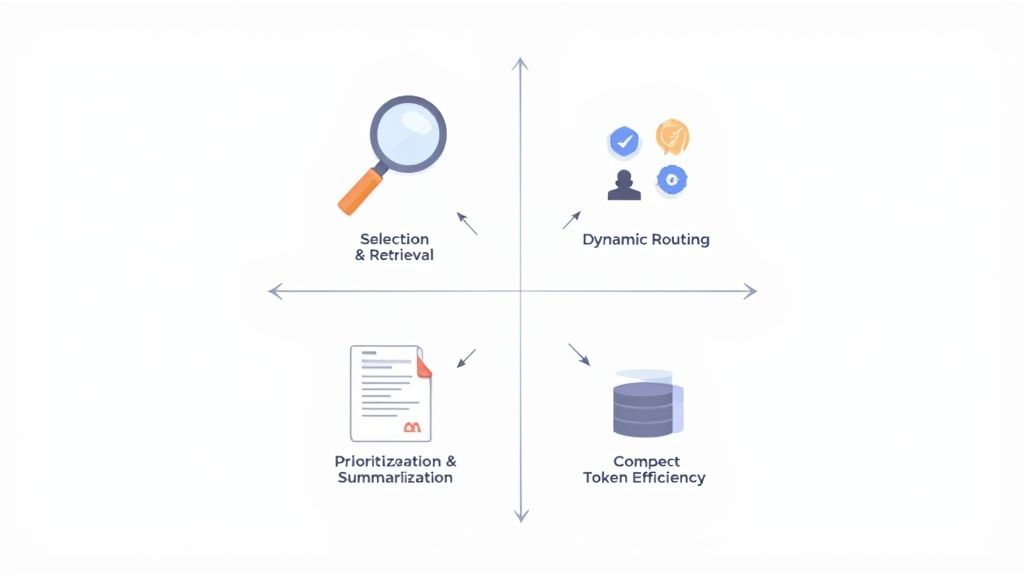
Each of these roles solves a different puzzle in making AI interactions feel smooth and genuinely helpful, from finding the right needle in a digital haystack to ensuring the final prompt doesn’t break the bank.
1. Context Selection and Retrieval
At its core, a context router’s first job is to be an expert researcher. Given a query, it must dive into a vast ocean of information—codebases, documents, databases, APIs—and return with only the most relevant snippets.
This isn’t just keyword matching. Modern routers use sophisticated techniques like semantic search to grasp the intent behind a question. This allows them to find conceptually related information, even if the exact words aren’t present.
For example, when a developer is stuck on an authentication bug, the router won’t just pull up files with “auth.” It’s smart enough to identify the relevant API docs, the specific microservice handling user logins, and recent error logs tied to that service. That precision is what separates a good AI response from a great one.
2. Dynamic Model and Tool Routing
Once the right context is secured, the router’s next job is to play dispatcher. Not all AI models are created equal; some excel at code, others at creative writing, and some at data analysis. A smart context router knows this and routes the task accordingly.
Consider a complex request: “Analyze our Q4 sales data, generate a summary for marketing, and draft a Python script to visualize the key trends.” An advanced router breaks this down:
-
It sends the sales data to a data-centric model or analysis tool.
-
The resulting insights are passed to a creative LLM to draft the summary.
-
Simultaneously, the visualization request goes to a code-generation model like Claude Code.
This dynamic routing ensures every part of the task is handled by the best tool. Platforms like the Cursor editor embody this philosophy, acting as that crucial routing layer between a developer’s IDE and the LLM.
The ultimate goal of dynamic routing is to build a “team” of specialized AI agents and tools, with the context router acting as the project manager that assigns tasks to the right expert every single time.
This function is a huge part of why context-aware computing is exploding. The market for these technologies was valued at $64.2 billion in 2024 and is expected to hit a staggering $368.7 billion by 2034. This growth is driven by the need to manage real-time data for everything from autonomous vehicles to personalized advertising. You can learn about the latest trends in context-aware computing to see where this is all heading.
Choosing the right routing strategy is crucial. Here’s a quick breakdown:
Comparing Different Routing Strategies
| Strategy | How It Works | Best For | Potential Drawback |
|---|---|---|---|
| Keyword-Based | Matches keywords from the query to metadata in data sources. | Simple, predictable queries where key terms are well-defined. | Fails to understand nuance or semantic meaning. |
| Semantic Search | Uses vector embeddings to find context that is conceptually similar. | Complex queries where user intent is more important than exact words. | Computationally more expensive than keyword search. |
| Rules-Based | Follows a predefined set of if-then rules to direct queries. |
Workflows with clear, structured decision points. | Brittle and hard to scale; can’t handle unexpected queries. |
| Model-Based | Uses a smaller, faster LLM to classify the query and decide which tool/model to use. | Multi-faceted requests that require different specialized tools. | Adds a small amount of latency and cost for the initial routing step. |
A sophisticated router might even combine these strategies, using rules for some tasks and a model-based approach for others to get the best of both worlds.
3. Prioritization and Summarization
Finding information isn’t enough; it must be presented effectively. LLMs pay more attention to information at the beginning and end of a prompt. The context router knows this and strategically organizes the data, placing the most critical pieces in these high-impact zones.
If the best context is buried in a 50-page PDF, sending the entire document would be a massive waste of resources. A good router can summarize it on the fly, extracting only the key paragraphs or data points relevant to the query. This ensures the LLM gets the signal without the noise.
4. Token Efficiency Management
Ultimately, all these functions contribute to the most business-critical one: managing token efficiency. In the AI world, tokens are currency. Every token sent to an LLM’s API and received back has a cost.
A context router is your best defense against runaway costs. By selecting only relevant data, summarizing long documents, and filtering out redundancy, it drastically shrinks the prompt size. This directly impacts your bottom line. A well-tuned router can easily slash token usage by 70-90%, translating directly into huge cost savings and much faster response times.
Practical Use Cases for Context Routers
The theory behind a context router for AI systems is powerful, but where does it deliver real-world value? This technology is quickly becoming essential for boosting efficiency and accuracy, turning a general-purpose AI into a highly specialized assistant.
These examples aren’t just about saving time. They represent a fundamental shift in how people interact with complex information, leading to measurable business improvements.
Accelerating Software Development
A developer’s most valuable resource is time, and a huge portion of it is spent digging through codebases, API docs, and bug tickets. Integrating a context router directly into their IDE can completely change that.
Imagine a developer needs to fix a tricky bug. Instead of hunting manually, they can ask their AI assistant, “Why is user authentication failing on this endpoint?”
The context router springs into action:
-
It scans the codebase: Pinpointing relevant microservices and authentication logic.
-
It grabs the right documentation: Finding specific API docs for that endpoint.
-
It checks issue trackers: Pulling up similar bug reports from Jira or GitHub Issues.
This curated information packet is sent to the LLM, which then provides a clear, helpful diagnosis. Teams using this method have seen a 40% reduction in time-to-resolution for complex bugs. Purpose-built tools like the Context Engineer MCP excel at this, acting as that intelligent intermediary between a developer’s query and the AI’s answer.
Enhancing Enterprise Customer Support
Customer support agents are under constant pressure to solve problems fast while navigating massive knowledge bases. An AI chatbot can help, but it’s only as good as the information it can find.
A context router empowers these chatbots to deliver the right answer instantly. When a customer asks, “My model X router keeps disconnecting,” the router doesn’t just search keywords. It digs through thousands of documents to find the specific troubleshooting guide for that exact model.
Major telecom providers now handle around 65% of initial customer interactions with AI assistants because their systems can access the right information on the spot. This is a massive win for both efficiency and customer satisfaction.
By providing the right information to the AI, companies are seeing up to a 30% increase in first-contact resolution rates. The AI transforms from a simple script-follower into a genuine expert.
Streamlining Legal and Financial Research
Professions like law and finance are built on information overload. A lawyer preparing for a trial sifts through decades of case law, while a financial analyst analyzes endless market reports. It’s slow work where a missed detail can have huge consequences.
A context router can search these enormous, unstructured databases in seconds. A lawyer can ask, “Find precedents for intellectual property disputes involving software patents in the last five years,” and the router will immediately pull the most relevant cases, summaries, and judicial opinions.
This rapid, precise access to data is a game-changer. The IT and telecommunications sector has seen AI adoption hit 38%, with AI projected to add $4.7 trillion in value by 2035. Context routers are a huge part of that story, turning overwhelming data into clear, actionable intelligence. You can discover the full scope of AI adoption statistics to see just how widespread this trend has become.
Best Practices for Implementing a Context Router
Building a context router for AI systems is more than a coding exercise; it’s a strategic infrastructure project. Following these best practices will ensure your router is a reliable, secure, and scalable part of your AI stack.
This screenshot from Context Engineering’s website gives a sense of an integrated approach where context sources are managed directly within a developer’s workflow.
This visual highlights how different sources, like code and documentation, can be organized and prioritized—a core principle for your own system.
Define Your Context Sources
You can’t route what you haven’t indexed. The first step is to map every potential source of context. This isn’t just listing databases; it’s understanding where valuable, decision-making information lives in your organization.
Common sources include:
-
Code Repositories: The entire codebase, including dependencies and commit history.
-
Internal Documentation: Wikis, Confluence pages, or Notion databases.
-
Databases: Both structured (SQL) and unstructured (NoSQL) data stores.
-
Real-time APIs: Services providing live data like system monitoring or financial feeds.
Once identified, each source must be indexed. This is often the most time-consuming part, but it’s the foundation for everything else.
Choose the Right Retrieval Strategy
With sources indexed, the next question is how the router will find information. This decision directly impacts accuracy and speed. A simple keyword search is fast but clumsy, often missing user intent.
For most modern systems, semantic search is far superior. It uses vector embeddings to grasp the conceptual meaning behind a query, finding relevant information even if keywords don’t match. For a practical guide, check out our article on setting up a vector store for context engineering . The key is to match your retrieval strategy to the AI’s intended tasks.
Performance and Scaling
A context router can easily become a bottleneck if not built for speed. Caching frequently accessed information is your first line of defense, cutting down on repetitive lookups.
Design the system to scale horizontally. Using containerization and load balancing allows you to add resources as demand grows, keeping the router responsive under pressure.
Security and Privacy
Security cannot be an afterthought. A context router has privileged access to sensitive information, and protecting it is non-negotiable. Implement strong access controls, typically by integrating with your company’s existing identity and access management (IAM) systems.
A context router must always follow the principle of least privilege. If a user doesn’t have permission to see a document on their own, the AI system they’re using shouldn’t be able to see it either.
Testing and Validation
Finally, create a solid plan for measuring router performance. Develop a “golden set” of queries with known ideal answers. Run these tests regularly to measure precision (how relevant the results are) and recall (how much relevant information was found).
This validation process provides hard data for fine-tuning the router’s algorithms over time. For more ideas on building robust systems, you might want to check out these best practices for optimizing AI systems .
The Future of Context-Aware AI
A context router isn’t just a clever optimization; it’s a glimpse into the future of human-AI collaboration. It’s the bridge between today’s powerful but generic models and tomorrow’s deeply specialized, context-aware digital partners. This is the technology that will make AI proactive, not just reactive.
As this field matures, the line between AI as a tool and AI as a collaborator will blur. Today, we spoon-feed information to models via prompts. The future, driven by a smart context router for AI systems, is one where the AI anticipates your needs before you even ask.
From Reactive Tools to Proactive Partners
Imagine an AI preparing for your next meeting by not just pulling related emails, but by analyzing your project’s codebase and recent team chats to flag potential technical issues. Picture an assistant that surfaces the right code patterns and API docs as you type, because it understands the problem you’re trying to solve.
That is the potential of a sophisticated context router. It’s about building an AI experience that feels less like a search engine and more like a conversation with a seasoned colleague who has perfect recall. This deep integration is possible when a system can intelligently weave together diverse information sources on the fly.
The next generation of AI won’t just answer our questions; it will help us ask better ones. By understanding the deeper context of our work, AI will prompt us with insights and connections we might have otherwise missed.
The Cornerstone of Next-Generation AI
Ultimately, context routing is the foundation for creating truly personalized and autonomous AI. The ability to dynamically select, prioritize, and route the right information will be what separates a basic chatbot from a powerful, integrated assistant that truly helps you get work done.
We are already seeing the first steps of this future with platforms like the Context Engineer MCP. These tools are building a direct, seamless bridge between a developer’s immediate workspace and the reasoning power of large language models. This evolution turns AI from something we command into something we collaborate with, making it a vital partner in solving complex problems. The future isn’t just about building bigger models; it’s about building smarter, more contextually-aware systems.
Frequently Asked Questions
When exploring context routers, a few common questions arise, especially regarding how they compare to existing tools. Let’s tackle the most frequent ones.
How Is a Context Router Different from a Simple RAG Pipeline?
This is a great question. While they seem similar, a context router is a major leap forward from a basic Retrieval-Augmented Generation (RAG) pipeline.
Think of a simple RAG setup as a librarian who can only pull books from one shelf—helpful, but limited. A context router is a master researcher. It sends a team to scour different libraries, pull from digital archives, check API documentation, and query live databases. It then intelligently sorts through everything to assemble the perfect briefing.
In short, a context router goes far beyond simple document retrieval. It can:
-
Connect to and query numerous diverse sources simultaneously—codebases, APIs, vector stores, etc.
-
Apply intelligent logic to score, rank, and select only the most relevant pieces of information.
-
Route the final, context-rich prompt to different specialized AI models based on the task.
Can I Build My Own Context Router?
Technically, yes, you could piece together a basic version with open-source tools. However, building a production-ready system that is fast, reliable, and secure is a massive undertaking. It requires deep expertise in data indexing, semantic search, distributed systems, and security.
For most teams, the engineering time and effort don’t make sense. This is why managed solutions are becoming the standard. A platform like Context Engineer MCP provides a battle-tested, optimized infrastructure out of the box. It saves hundreds of development hours, letting you focus on your core application instead of reinventing the wheel.
What Are the Biggest Implementation Challenges?
Getting a context router running smoothly involves overcoming a few key hurdles:
-
Data Silos: A company’s most valuable information is often scattered. Securely connecting to and indexing all these different sources without creating a mess is the first major challenge.
-
Relevance Tuning: Consistently pulling the right information is more art than science. It takes significant fine-tuning to teach the system what’s truly useful versus what’s just noise.
-
Scalability: A successful router will see high usage. It must be built from day one to handle a high volume of requests without becoming a bottleneck.
-
Security: This is non-negotiable. Airtight, granular access controls are essential to ensure the router only surfaces data a specific user has permission to see.
At Context Engineering, we believe that providing AI with precise, relevant information is the key to unlocking its full potential. Our Model Context Protocol (MCP) server integrates directly into your IDE to eliminate hallucinations and streamline development by giving AI agents the exact project context they need. Learn how to build more reliable software faster at contextengineering.ai .